Phone
Regulatory Evidence & Operational Governance
A regulatory evidence and operational governance platform for UAS operators.
Mission submission, approval workflow, field execution, vendor log ingestion, and retention-controlled evidence storage — in one platform designed to support operators flying under their own UASOC. Designed to support compliance with SACAA Part 101 and aligned operational frameworks, with preparation of structured risk assessments aligned with JARUS SORA methodology for submission to the applicable aviation authority — available on Fleet and Enterprise tiers.
Advisory by platform · Authorised by operator · Recorded end to end
01Positioning
A regulated service, delivered as a platform.
What this is
FlightDocket is a regulatory evidence and operational governance platform for organisations operating under their own UASOC. Every mission is structured end to end. Every artefact is retained with integrity controls. Every credential is surveilled. The platform is the same whether you operate two aircraft or two hundred.
What it is not
It is not drone management software. It is not a flight planner. It is not a regulatory authority. FlightDocket does not grant approvals, certifications, or authorisations. Your appointed approver remains the authorising party on every mission. The platform's role is to provide structured operational records, audit trails, and decision-support tooling aligned to regulatory requirements — every time, for every operation, without exception. Final regulatory authority and approval remain with the applicable aviation authority.
02Advisory Authority
The platform advises.
The operator authorises.
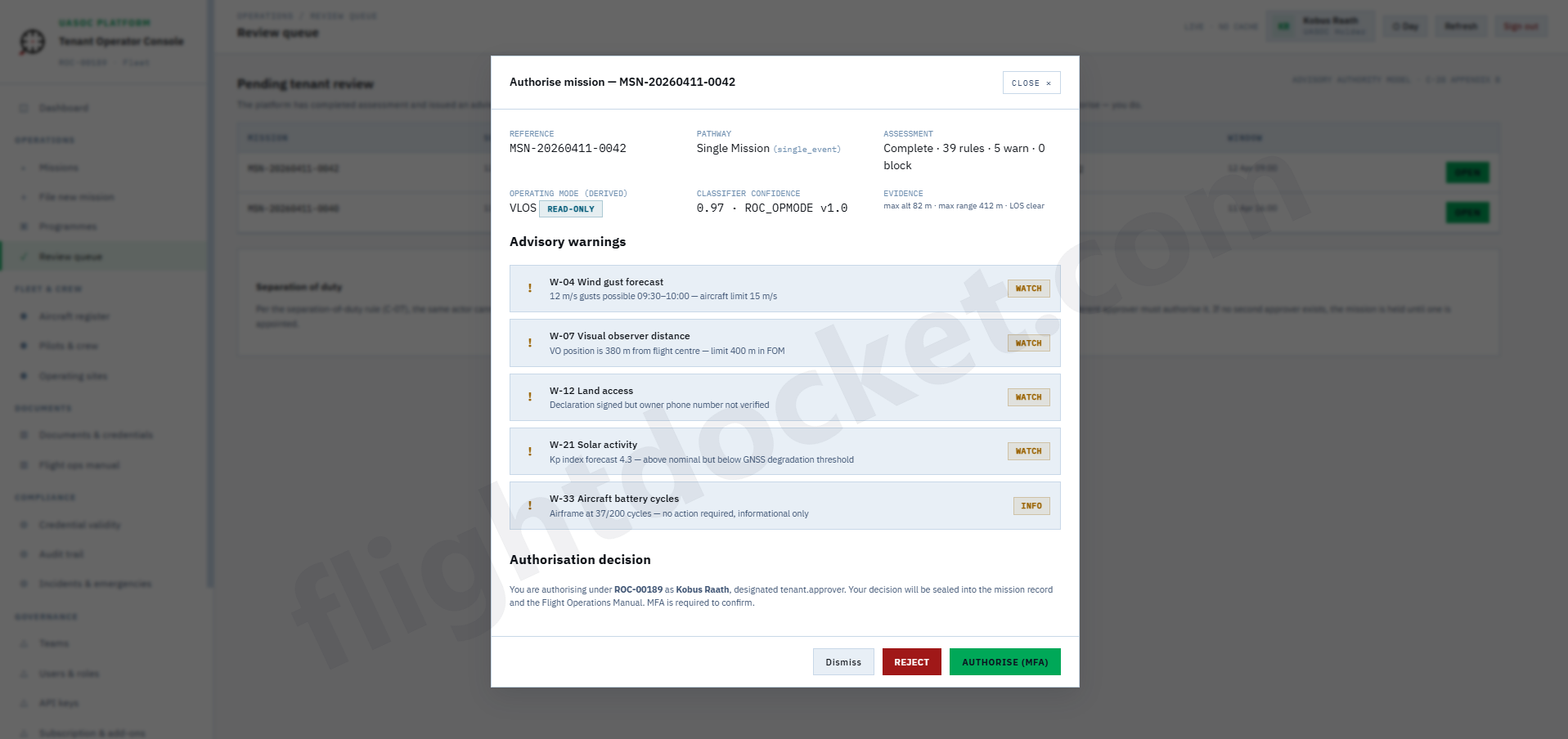
Every mission is assessed end-to-end before it can be flown. The platform runs the four-phase assessment pipeline and issues an advisory package: warnings, blocking gates, evidence links, confidence score.
That advisory is not authorisation. The tenant approver reviews, records their reason, and authorises under their own UASOC. Authorisation is a deliberate human act with an MFA signature. The platform never signs off on its own mission.
Review queue / Authorisation
Pre-Launch build
01Authority Model
Advisory and authority.
FlightDocket issues advisory against every mission. The tenant-appointed approver retains authorisation. Authority never transfers.
Platform tooling complements the operator. It does not replace the UASOC holder.
“An operation is only as credible as its record.”
FlightDocket / Design Principle 01
03The Mission Brief
Everything converges into one document.
The Flight Operations Manual.
Weather, airspace, hazards, radio scripts, satellite maps, checklists, emergency contacts, crew fitness. Every data source the platform assesses is consolidated into a single operational brief, versioned and issued before the aircraft leaves the ground. This is the document the pilot holds, the approver signs, and the regulator audits.
Flight Operations Manual
The final output of every mission assessment. A complete, defensible operational brief generated from live data — weather, airspace, hazards, radio scripts, checklists, and interactive maps. Ready to print, ready for the regulator.
15 sections · Interactive satellite maps
ICAO 5×5 SMS hazard register · Radio call scripts
IMSAFE self-assessment · SACAA Part 101
Pre-flight checklists (Groups A–H)
ICAO 5×5 SMS hazard register · Radio call scripts
IMSAFE self-assessment · SACAA Part 101
Pre-flight checklists (Groups A–H)
View full specimen →
And for Part 108 specific-category operations — a separate dossier.
A FOM brings one mission to the runway. A Part 108 dossier — a structured risk assessment aligned with JARUS SORA methodology and prepared for submission to the applicable aviation authority — brings an entire programme of missions into regulatory scope. Once the regulator authorises the programme, one authorisation covers multiple FOMs flown under it. The platform prepares both artefacts. Every FOM issued under an authorised programme references the regulator's authorisation as its authorising basis.
Part 108 Authorisation Dossier
Generated from a completed JARUS SORA v2.5 ten-step assessment. GRC and ARC computed from mission parameters, mitigations proposed and applied, 24 OSOs scored, SAIL classified, ConOps written. Structured to support a SACAA Part 108 authorisation submission — prepared once per programme, with authorisation issued by the applicable aviation authority and covering every sortie flown inside it.
JARUS SORA v2.5 ten-step · 24 OSO table
GRC + ARC + SAIL · ConOps generator
Mitigation plan · OSO robustness evidence
PDF + JSON + JARUS-conformant XML
GRC + ARC + SAIL · ConOps generator
Mitigation plan · OSO robustness evidence
PDF + JSON + JARUS-conformant XML
View full specimen dossier →
Two pathways · two artefacts · one evidence chain
Part 101 — standard Remote Pilot Operations
Mission or programme → FlightDocket assessment → your approver authorises under your own UASOC → fly, with battery swaps logged as micromissions or microsorties → close. No SACAA per-operation approval. This is the standard pathway for VLOS, EVLOS, BVLOS, and night operations inside your approved UASOC modes. Programmes are operator-internal envelopes covering 1, 3, or 6 months; all authorisation remains with your appointed approver. This is the existing workflow; nothing changes.
Part 108 — specific-category operations
For operations outside the standard Part 101 modes in your UASOC — for example, BVLOS over populated areas without existing dispensation or complex urban corridor work — regulatory authority cannot be granted internally. FlightDocket runs the JARUS SORA v2.5 ten-step risk assessment, produces a Part 108 authorisation dossier, and the operator submits the dossier to SACAA. SACAA authorises (or refuses) the specific-category operation. Once authorised, missions are flown under the SACAA authorisation and still generate ordinary FOMs. New pathway, used only when Part 101 does not cover the operation.
How the artefacts pair up
A FOM is issued per mission in both pathways. A Part 108 dossier is prepared once per specific-category authorisation period (typically 3 or 6 months) and used only when Part 108 applies. Under a SACAA- authorised Part 108 programme, each mission's FOM references the regulator's authorisation as its authorising basis; under Part 101, each mission's FOM references the operator's own approver decision. Both artefacts are SHA-256 hashed, stored in a versioned, retention-controlled evidence archive with integrity verification, and disclosable to a regulator through a time-bound read-only grant.
04What this replaces
One system, not six disconnected ones.
Most UASOC holders today run their compliance through a mix of tools that were never designed to work together: a commercial flight planner, a spreadsheet of PIC credentials, an email chain with the appointed approver, a shared drive for FOMs, a WhatsApp group for the field crew, and a compliance consultant billed by the hour when the auditor calls.
Every link in that chain is a place where something goes missing. A mission that flew but was never closed. A pilot whose medical lapsed and nobody caught it. A FOM that was sent but never acknowledged. An evidence bundle that cannot be reconstructed after the fact.
FlightDocket replaces the whole chain with one platform where the mission workflow, the records, the field execution, and the evidence are all the same object — structured to support regulatory review.
05Platform
The operational lifecycle.
End to end.
Eight integrated domains, engineered as one governance platform producing structured operational records. No bolt-ons, no exports, no re-keying. Designed to support compliance with SACAA Part 101 end to end, with Part 108 specific-category preparation through a JARUS SORA v2.5 assessment layer — the platform prepares the dossier; the applicable aviation authority grants authorisation.
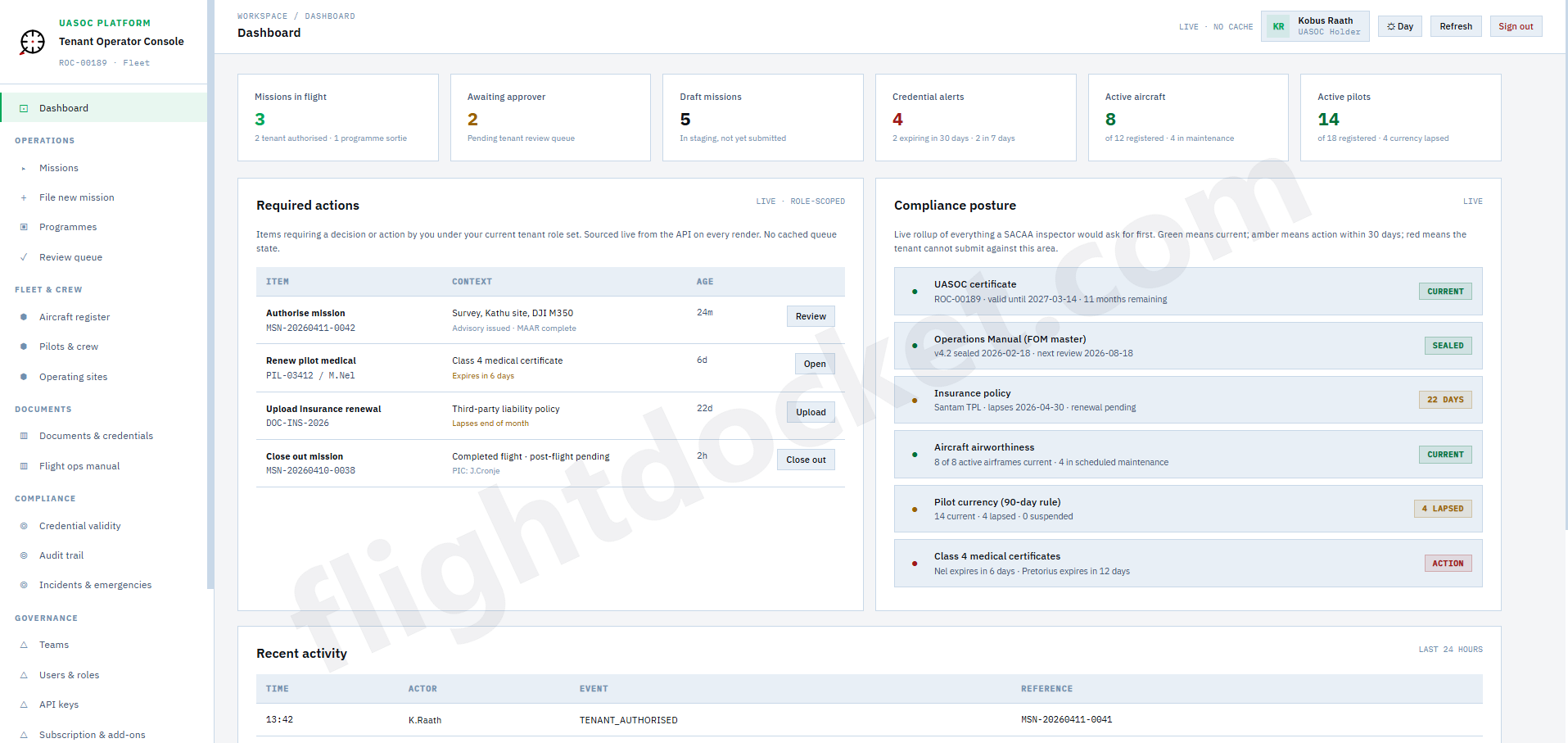
Tenant operator console / Dashboard
Pre-Launch build
01
Governance
Mission Pipeline
Every mission passes through a governed lifecycle from intake to closure. Pre-flight readiness is established across crew, aircraft, credentials and environment before authorisation. No parallel paths. No bypass. The record of what was checked, by whom, and when, is preserved for the life of the operation.
02
Documentation
Flight Operations Manuals
Operator-branded FOM bundles are issued from live mission data. Each bundle is versioned, cryptographically hashed, and delivered to the crew and the archive in the same operation.
03
Monitoring
Credential and Airworthiness Surveillance
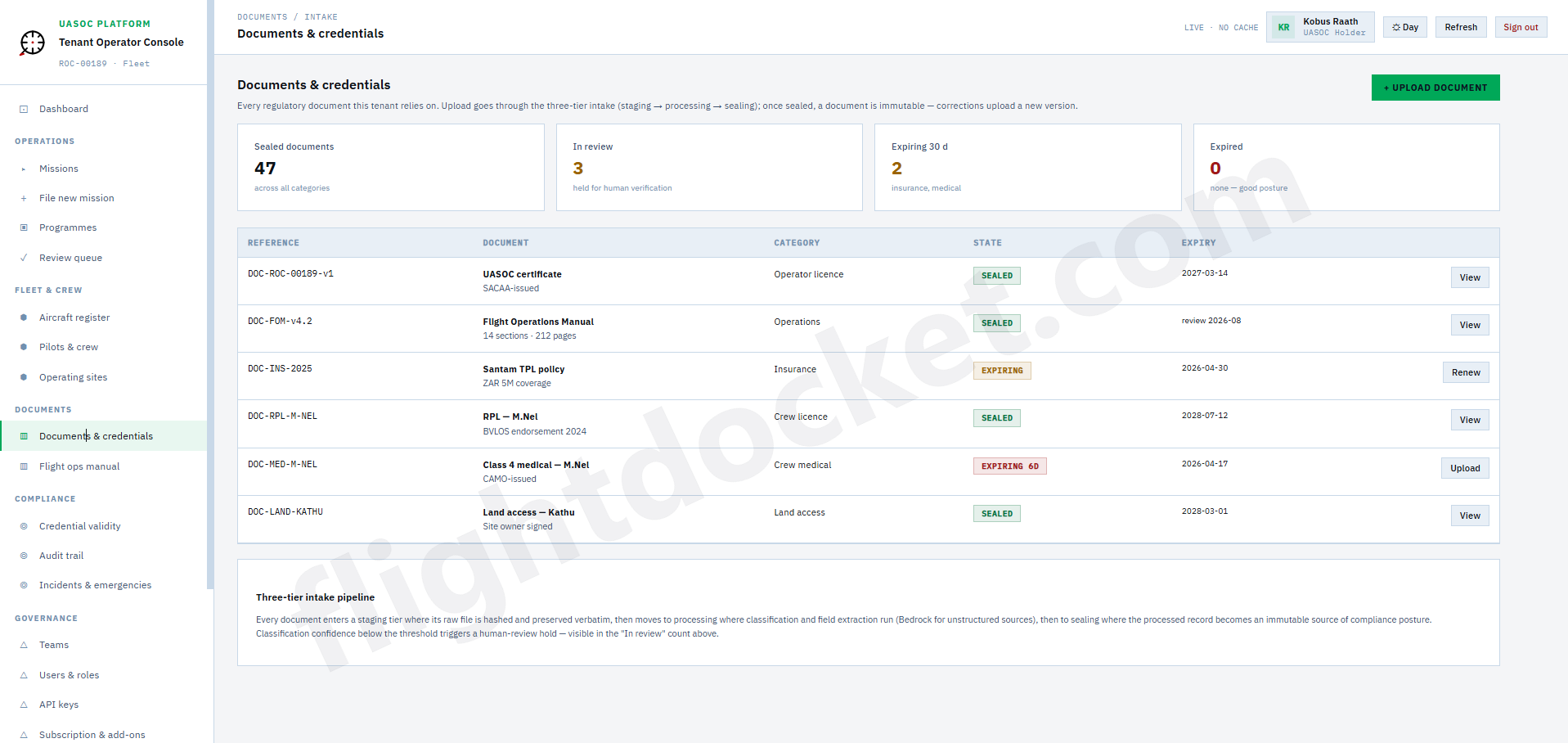
Pilot licences, medicals, aircraft registrations, operating certificates and insurance are monitored continuously. Expiries surface well before they become operational constraints. Nothing lapses in silence. Nothing gates a mission by surprise.
04
Retention
Evidence Archive
Evidence records are stored using versioned, access-controlled, and retention-governed storage with cryptographic integrity controls, designed to support long-term evidentiary requirements (including multi-year retention). SHA-256 hashed at point of capture, append-only by construction, and retrievable by the operator for disclosure to regulators, insurers, boards, or auditors. Evidence retention and integrity controls are designed to support audit and regulatory review; interpretation and acceptance of such evidence remain the responsibility of the reviewing authority.
05
Execution
Field Client
A purpose-built mobile client runs in the field. Ground crews check in, confirm pre-flight state, log execution, and close missions against the same operational record held in the office. Offline tolerant. Connectivity synced. One source of truth across the operation.
06
Integration
Vendor Log Ingestion
Link a supported drone-vendor flight platform to import fleet data, synchronise flight logs, and track firmware status automatically. The platform ingests your vendor data; it does not replace it. Your vendor system remains the source system for aircraft telemetry while FlightDocket provides the structured operational record around it.
07
Safety
Safety Management System
Hazard register, occurrence reporting, corrective action tracking to closure, change management workflow, and organisation chart with accountable-position register — structured to ICAO Annex 19 and the SACAA SMS expectations. When an occurrence is linked to a mission, the audit trail connects the two without re-keying. SMS is not a separate system; it is the same evidence chain.
08
Part 108
Specific-Category Assessment and Dossier Service
Supports preparation of structured risk assessments aligned with JARUS SORA methodology for submission to the applicable aviation authority. Ground Risk Class, Air Risk Class, mitigation recommendations across M1 / M2 / M3, 24 OSO review, SAIL 1-6 classification, and ConOps generation. The assessment workspace is active on Fleet and Enterprise tiers; Starter and Professional tenants see the workspace in inactive (greyed) state with an upgrade prompt — the platform shows what is available rather than hiding it. Dossier preparation is transactional (pricing TBC at launch) for standard operations, or a referral to the vetted consultant panel when the platform classifies the operation as novel. Operators may override a novel classification through a signed accountability waiver (fee TBC at launch). Final authorisation rests with the applicable aviation authority. See specimen Part 108 dossier →
•FlightDocket / Mission Pipeline
Stage 01 of 08 / Auto-playing
01 · INTAKE
|
0% complete
06Field Client
In the field.
On the same record.
A purpose-built field client runs on the pilot's phone. Pair the device to your operator account, receive the versioned FOM bundle, run pre-flight and post-flight checks at the aircraft, and close the mission — all against the same structured operational record held in the office.
Offline tolerant. Attribution is cryptographically bound to the device at pairing. Every event is signed at the source and written to the integrity-verified evidence archive the moment connectivity returns.
Bind
QR pair to operator account
Fly
FOM and checklist at the aircraft
Seal
Append-only evidence on sync
09:41

FlightDocket
Field Client
1
Ready
3
Pending
12
This week
Next mission
Secunda 132 kV · sector 7B
Pair · Fly · Seal
07Evidence of Record
Every mission leaves a record.
Every record is defensible.
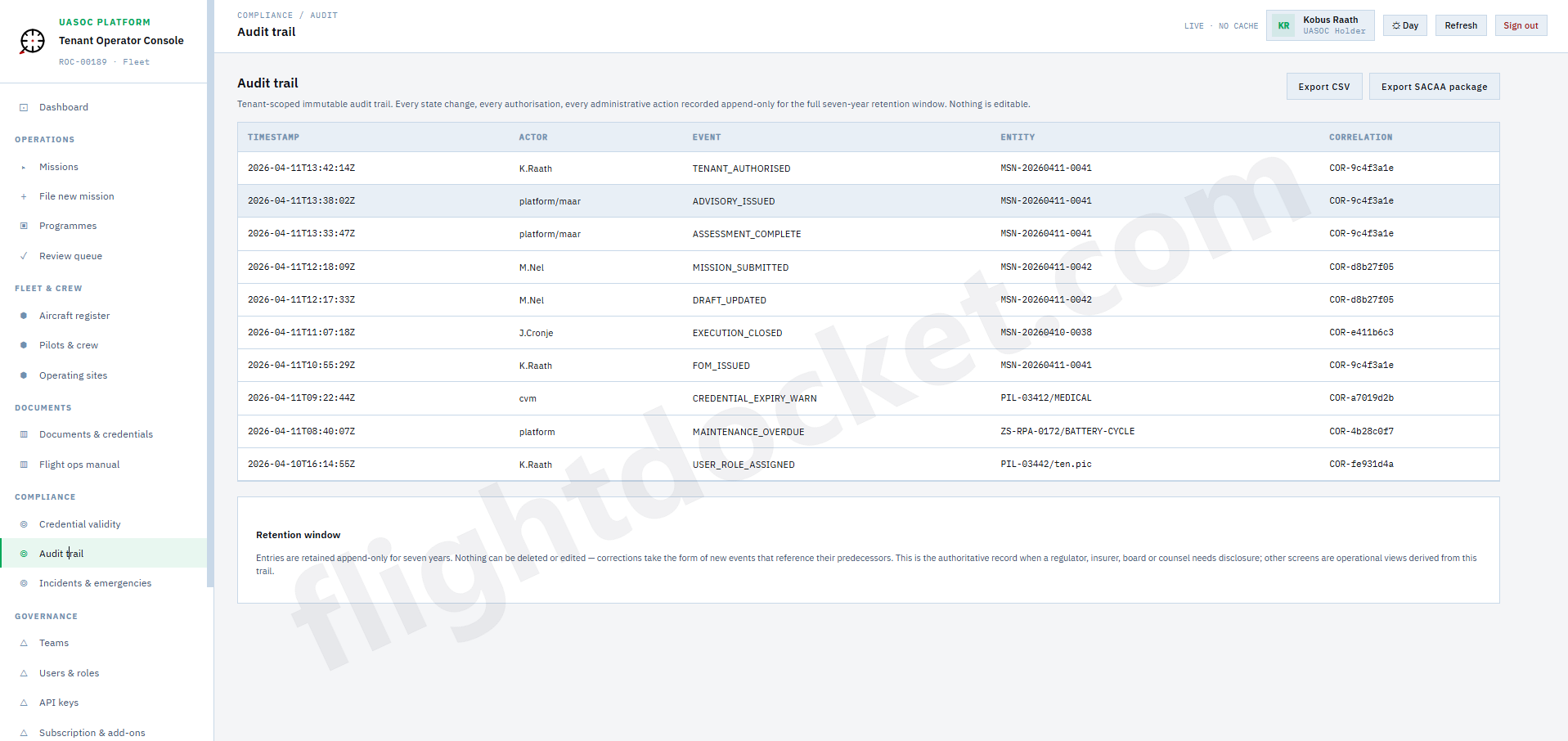
Regulators audit records. Insurers audit records. Boards audit records. FlightDocket treats every mission as evidence of record from the moment it is staged. Every artefact produced along the way is captured, hashed, and retained in a versioned, retention-controlled, append-only archive with cryptographic integrity controls, designed to support long-term evidentiary requirements including multi-year retention.
Nothing is re-keyed. Nothing is reformatted. Nothing is lost. When the question comes, from the regulator, the insurer, the board, or counsel, the answer is ready, complete, and verifiable against its original hash. Interpretation and acceptance of evidence remain the responsibility of the reviewing authority.
Audit trail / Retention-controlled archive
Pre-Launch build
08Document Validity
Nothing lapses in silence.
Nothing gates a mission by surprise.
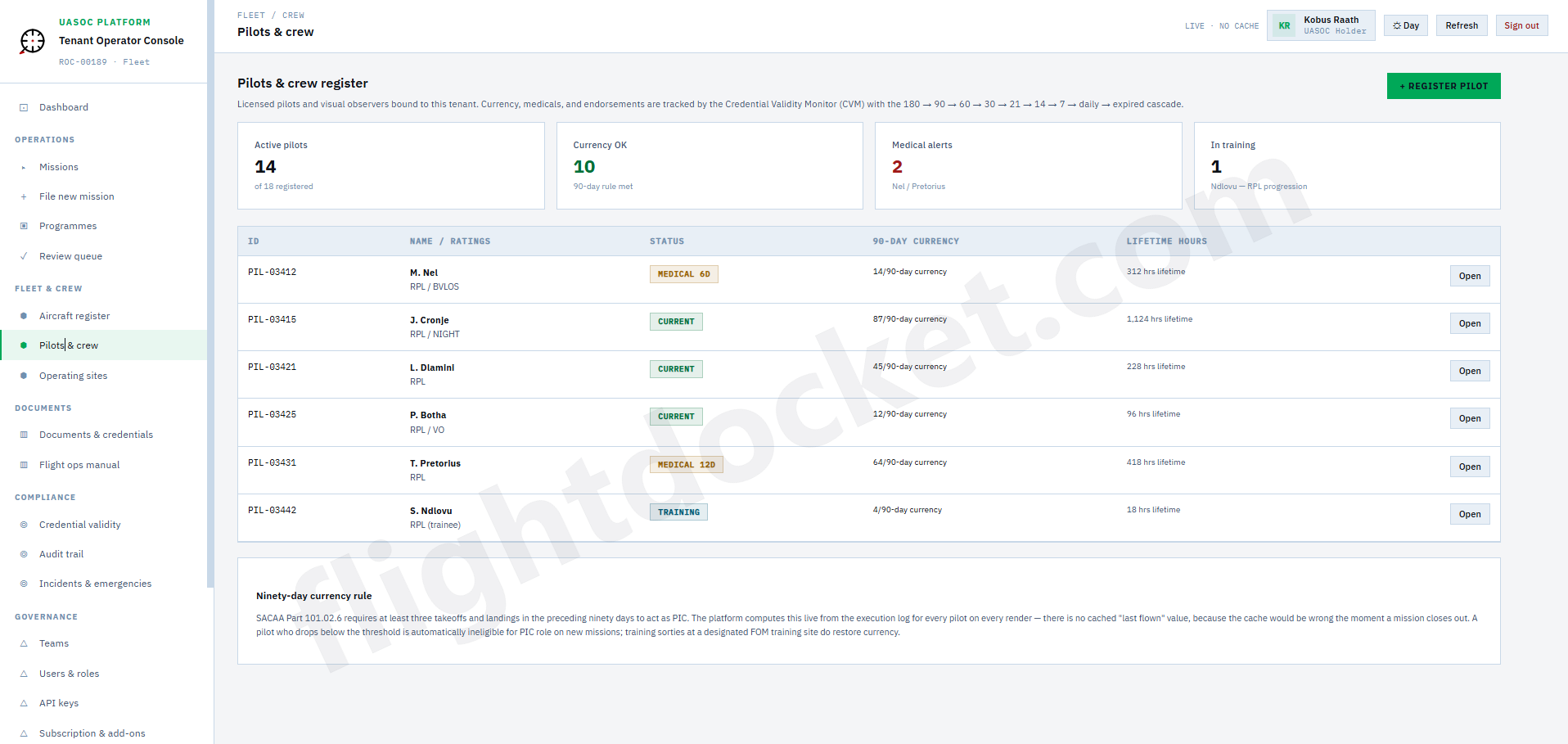
Pilot licences, medicals, aircraft registrations, operating certificates, insurance. Each is tracked against a cascade of warning bands. A document at one hundred and eighty days to expiry reads differently from a document at thirty days, which reads differently from a document at seven. The cascade surfaces well before anything becomes an operational constraint.
Documents & credentials
Pre-Launch build
Pilots & crew register
Pre-Launch build
03Credential Bands
Warnings cascade, not surprises.
Pilot licences, medicals, aircraft registrations and operating certificates are monitored against an 8-band warning cascade. Nothing expires in silence.
180d
90d
60d
30d
21d
14d
7d
0d
180 days out
30 days
Expiry and beyond
Window
Band
Notification
Behaviour
Colour
180d → 90d
Nominal
Monthly notice
Informational
#34D399
90d → 60d
Early
Monthly notice
Operator reminder
#2DD4BF
60d → 30d
Advisory
Weekly notice
Action recommended
#7DD3FC
30d → 21d
Warning
Weekly notice
Action required
#F59E0B
21d → 14d
Escalation
Twice weekly
Action required
#F97316
14d → 7d
Urgent
Daily notice
Compliance officer
#F97316
7d → 0d
Critical
Daily notice
Missions gated
#EF4444
0d → +
Expired
On expiry
All ops blocked
#DC2626
Behaviour: informational → advisory → warning → critical → blocked.
09Regulatory alignment
Built against international and South African standards.
FlightDocket's assessment pipeline, evidence model, and audit reports are structured to the frameworks below. The platform provides decision-support, record management, and evidence structuring aligned to regulatory requirements. Final regulatory authority and approval remain with the applicable aviation authority and, for operational decisions under a UASOC, with the operator.
SACAA
South African Civil Aviation Authority
CAR/CATS Part 101 · TGM Part 101 Ops Manual
ICAO
International Civil Aviation Organization
Annex 19 Safety Management · Doc 9859 Ed.4
JARUS
Joint Authorities for Rulemaking of Unmanned Systems
SORA v2.5 specific-category framework
ECCAIRS
European Coordination Centre for Accident & Incident Reporting
Taxonomy · E5X export format
POPIA
Protection of Personal Information Act
Act 4 of 2013 · South Africa
ASL Act
Air Services Licensing Act
Act 115 of 1990 · South Africa
Alignment, not endorsement. FlightDocket is not a SACAA system, not an ICAO-accredited system, not a JARUS-endorsed tool, and not an ECCAIRS-certified reporting gateway. The platform structures records and exports against these frameworks so that an operator's records and reports are prepared to support regulatory review in the relevant format. FlightDocket is not a regulatory authority and does not grant approvals, certifications, or authorisations. All operational approvals, certifications, and regulatory decisions remain the responsibility of the applicable aviation authority; operational authority under a UASOC rests at all times with the UASOC holder.
10Subscription
Four tiers.
One platform.
Flat pricing.
One subscription covers compliance administration, active record control, and retention-controlled operational evidence across every tier. Your monthly mission credit pool is included in the fixed fee — you are not billed separately for credits used within it. Rates are flat across complexity, night, controlled airspace, and restricted-area operations. Fleet and Enterprise tiers additionally unlock the Part 108 specific-category dossier service (assessment free; issuance pricing TBC at launch). Subscription pricing TBC at launch.
| Starter | Professional | Fleet | Enterprise | |
|---|---|---|---|---|
| Operator profile | Small operators | Medium operators | Large operators | Corporate · government |
| Active aircraft | Up to 8 | Up to 25 | Up to 70 | Unlimited |
| Active PICs | Up to 15 | Up to 50 | Up to 150 | Unlimited |
| Included MC pool / month | 220 MC | 600 MC | 1,650 MC | 4,000 MC |
| Rollover cap / life | 110 MC / 2 mo | 240 MC / 3 mo | 550 MC / 4 mo | 900 MC / 4 mo |
| Base annual fee | TBC | TBC | TBC | TBC |
| Monthly equivalent | TBC | TBC | TBC | TBC |
| Subscribe → | Subscribe → | Subscribe → | Subscribe → |
Indicative pricing. Tier structure is locked; final pricing is confirmed at general availability and subject to the FlightDocket service agreement.
Regulatory basis — SACAA Part 101
Mission, Programme, Sortie — how flight operations are classified.
These are platform-defined operational terms aligned to common regulatory concepts used in Part 101 operations, with reference to CAR Part 101 (25th and 26th Amendment, 2023) and the TGM Part 101 Operations Manual (26 August 2025). They are used within the platform to structure operational records and do not replace or redefine official regulatory terminology. The platform's classification model follows one regulatory principle: SACAA approval is granted at the operation level, not the individual flight level. Record-keeping applies to every flight; approval applies to the operation that authorises those flights.
Regulatory and standards framework the platform is built against: SACAA CAR/CATS Part 101 (RPAS commercial operations), TGM Part 101 Operations Manual, the Air Services Licensing Act 115 of 1990, ICAO Annex 19 (Safety Management), JARUS SORA v2.5 (specific-category risk model, forward design), ECCAIRS (occurrence taxonomy and E5X export), and the Protection of Personal Information Act 4 of 2013 (POPIA) for personal data handling. All audit and compliance reports produced by the platform are structured against one or more of these frameworks.
01 · Mission (Single Event)
One approved flight operation at one location, within one time window.
A standalone one-off mission submitted to the UASOC for every
flight. Follows the full MAAR approval pipeline. One aircraft,
one PIC, one time window measured in hours (not days). The
mission itself is the SACAA-approved operation, and becomes
the authorising document under Part 101.
02 · Programme (Envelope)
Pre-approved operational permission for repeated work in a defined area.
Covers a defined location, operating mode, mission type and
subtype, approved aircraft pool, approved pilot pool, and a
fixed duration (1, 3, or 6 months). Submitted to the ROC
once and approved once.
Within the approved envelope, multiple sorties may be flown
without further UASOC review. The programme is the authorising
document.
03 · Sortie
A flight operation inside an approved programme.
One flight window within the programme's validity. The
platform revalidates against live weather, airspace status,
NOTAMs, and credential currency, then auto-approves when all
checks pass. The regulatory authority comes from the
parent programme — the sortie inherits it. A
sortie cannot exist outside an approved programme.
04 · Micromission / Microsortie
One continuous flight, bounded by battery insertion and removal.
A battery change is a new flight, not a new mission.
Part 101 requires every flight to be logged. Micromissions
(inside single-event missions) and microsorties (inside
sorties) capture that flight-level record for the logbook
— aircraft, PIC, launch and recovery time, battery
state, flight duration. They do not re-open an approval, and
they do not attract a mission credit charge. They are a
record-keeping requirement, not an approval event.
Regulatory principle — CAR Part 101
Approval is at the operation level. Logbook is at the flight level. A Mission or a Programme is one SACAA-approved operation. Inside the approved window, the crew flies as many battery cycles as the operation requires, and each individual flight is logged as a Micromission or Microsortie record. No additional approval is needed for a battery swap. No additional mission credit is charged. Sources: CAR Part 101 approval model; TGM Part 101 Operations Manual (26 August 2025); platform implementation in C-05 Mission Pipeline §3.1, §3.2, §11.3 and C-06 Field Execution Amendment A1 (2026-04-08).
Scope boundary — what the platform is, and is not
FlightDocket is a decision-support and operational-record system for SACAA Part 101 RPAS operations conducted under a UASOC, with a Part 108 specific-category assessment layer built on JARUS SORA v2.5.
For Part 101 operations, the operator's appointed approver authorises every mission or programme internally under their own UASOC. No SACAA per-operation approval is required or claimed.
For Part 108 specific-category operations — operations outside the Part 101 modes in the operator's UASOC — the platform produces a SORA dossier that the operator submits to SACAA. SACAA is the authorising body for Part 108 operations; the platform is advisory and the operator's approver accepts the dossier internally before submission. FlightDocket does not self-authorise Part 108 operations, and does not replace any function of SACAA, ATNS, or any civil aviation authority.
Part 102 specific-authorisation operations and Part 127 commercial air services / ATC coordination are outside current platform scope.
Automation — assistive, never authoritative
Where the platform applies automation to support mission preparation — environmental and terrain assessment, post-flight review, structural review, narrative validation — every output is treated as advisory input to a human decision. Automation never issues a regulatory authorisation, never bypasses a policy gate, and never sits on the critical path for mission approval. The operator's appointed approver reviews the data and decides. Every automated output is versioned and retained in the evidence archive so the exact input-to-output state is reproducible on review. If an automated service is unavailable, the mission pipeline falls back to deterministic policy rules and continues to operate; no approval depends on automation being available. Automation speeds up the preparation of a mission, it does not automate the authorisation of one. The operator's Part 101 authority is unchanged by any automated capability on the platform.
Regulatory boundary — formal statement
FlightDocket is not a regulatory authority and does not grant approvals, certifications, or authorisations.
The platform provides decision-support, record management, and evidence structuring aligned to regulatory frameworks.
All operational approvals, certifications, and regulatory decisions remain the responsibility of the applicable aviation authority.
Commercial clarity — C-14 v2 §2.2
Included in the subscription, not included, charged extra.
Included in the subscription
- Platform access and all user accounts — no per-seat fee
- Aircraft record administration and validity checks
- Pilot-in-command record administration and validity checks
- Operator compliance record administration
- Monthly mission credit pool (sized to tier)
- Credit rollover within tier-specific cap and life
- Mission intake and full assessment workflow
- Active document surveillance and notification cascade
- Versioned, retention-controlled evidence archive with multi-year retention (SHA-256 integrity verification, Object Lock)
- Mobile field client and offline mission execution
- FOM generation and programme envelope documents
- Micromission and microsortie continuations
- Official communications workflow (drafting, dispatch, filing)
Not included
- Human mission approval by the operator's appointed approver — retained by the operator under their own UASOC authority
- External CMA or consultant fees where the operator engages them directly
- Third-party vendor subscriptions (drone-vendor flight platforms, telemetry services, weather feeds)
- Regulator fees payable to SACAA
- Insurance, aircraft certification, or crew medical costs
- Ground infrastructure (radios, observers, site permissions, airspace authorisations)
Charged extra when used
- Overflow mission credits via self-service top-up packs (see Commercial Principles for rates)
- Out-of-bundle active aircraft beyond tier cap (tier-dependent monthly rate, pro-rata)
- Out-of-bundle active PICs beyond tier cap (tier-dependent monthly rate, pro-rata)
- Value-added tax at 15% for South African entities
Team structure is a Fleet and Enterprise tier entitlement. Internal interdepartmental chargeback, external client billback, direct integration with the tenant's own accounting system, and custom integrations are Enterprise tier entitlements. See the feature matrix below for the exact tier coverage of every feature.
Feature matrix — full entitlement by tier
Every feature, every tier, with the real differences visible.
Every tier runs on the same codebase, pipeline, mobile client, and evidence archive. Differentiation sits in four places: vendor integration (Professional and above), team structure and operations (Fleet and Enterprise), cost recovery — internal chargeback, external client billback, direct accounting integration — (Enterprise only), and Part 108 specific-category dossier service (Fleet and Enterprise). Tier capacity and per-unit economy-of-scale values are collapsed below by default; expand to see the detail.
✓Active
—Visible but inactive at this tier
valueEntitlement at this tier
Tier-restricted features remain visible in the operator workspace at all subscription levels — rendered greyed out, with an upgrade prompt — consistent with the platform's UI principle of showing what is available rather than hiding it.
| Feature | Starter | Professional | Fleet | Enterprise |
|---|---|---|---|---|
| Feature parity rows below are the same on all four tiers. | ||||
| Capacity and entitlements | ||||
| Active aircraft cap | Up to 8 | Up to 25 | Up to 70 | Unlimited |
| Active pilots-in-command cap | Up to 15 | Up to 50 | Up to 150 | Unlimited |
| Monthly mission credit pool (included) | 220 MC | 600 MC | 1,650 MC | 4,000 MC |
| Credit rollover cap and life | 110 MC / 2 mo | 240 MC / 3 mo | 550 MC / 4 mo | 900 MC / 4 mo |
| Mission operations | ||||
| Mission staging, intake workspace, and file ingestion (common industry formats) | ✓ | ✓ | ✓ | ✓ |
| Formal mission submission with boundary seal and full assessment workflow | ✓ | ✓ | ✓ | ✓ |
| Single-event and programme-plus-sortie pathways (1, 3, 6 month programmes) | ✓ | ✓ | ✓ | ✓ |
| BVLOS, EVLOS, RVLOS, and night operations | ✓ | ✓ | ✓ | ✓ |
| Complexity-flat mission credit pricing (no surcharge for complex operations) | ✓ | ✓ | ✓ | ✓ |
| Emergency operations (capability-flag gated) | ✓ | ✓ | ✓ | ✓ |
| Merit-based review queue with auto-approval for qualifying sorties | ✓ | ✓ | ✓ | ✓ |
| Airspace awareness, NOTAM surveillance, live weather, and terrain assessment | ✓ | ✓ | ✓ | ✓ |
| Logbook records | ✓ | ✓ | ✓ | ✓ |
| Compliance governance | ||||
| Aircraft, PIC, and document credential validity surveillance (cascade alerts) | ✓ | ✓ | ✓ | ✓ |
| OM / UASOC compliance record administration | ✓ | ✓ | ✓ | ✓ |
| Policy engine (configurable parameters driven by platform administration) | ✓ | ✓ | ✓ | ✓ |
| Immutable audit trail with SHA-256 chained governance event stream | ✓ | ✓ | ✓ | ✓ |
| Versioned, retention-controlled evidence archive with integrity verification (append-only storage, multi-year retention) | ✓ | ✓ | ✓ | ✓ |
| Legal hold support and regulatory reporting on demand | ✓ | ✓ | ✓ | ✓ |
| Recognition, SLA, and intelligent optimisation | ||||
| Four-dimension operational quality scoring (submission, execution, incident handling, closure) | ✓ | ✓ | ✓ | ✓ |
| Trust level progression (Assisted → Supervised → Delegated → Trusted) with earned SLA targets | ✓ | ✓ | ✓ | ✓ |
| Faster auto-approval and higher queue priority at higher trust levels | ✓ | ✓ | ✓ | ✓ |
| SLA breach credit compensation | ✓ | ✓ | ✓ | ✓ |
| Intelligent package advisor (rolling usage analysis, upgrade/downgrade guidance, programme-bundling suggestions) | ✓ | ✓ | ✓ | ✓ |
| Billing, credits and rejection protection | ||||
| Monthly included mission credit pool with rollover | ✓ | ✓ | ✓ | ✓ |
| Credit advance facility and self-service top-up packs | ✓ | ✓ | ✓ | ✓ |
| Platform-caused rejection and NOTAM cancellation: 100% MC refund | ✓ | ✓ | ✓ | ✓ |
| Tenant-error rejection: refund as per pricing tier | ✓ | ✓ | ✓ | ✓ |
| Programme-bundle efficiency (sorties cheaper than standalone missions) | ✓ | ✓ | ✓ | ✓ |
| Official communications included | ✓ | ✓ | ✓ | ✓ |
| Teams — structure and operations (Fleet and Enterprise) | ||||
| Unlimited teams as business units with aircraft / pilot / crew / observer assignment | — | — | ✓ | ✓ |
| Team portal, sub-workspace, and team-scoped access control | — | — | ✓ | ✓ |
| Per-team mission attribution, credit consumption, and utilisation tracking | — | — | ✓ | ✓ |
| Team dashboard and cross-team usage comparison reports | — | — | ✓ | ✓ |
| Cost recovery — internal chargeback and external client billback (Enterprise only) | ||||
| Team cost centre designation and internal chargeback rate configuration | — | — | — | ✓ |
| Team cost allocation and billback data exports (CSV / PDF) | — | — | — | ✓ |
| Shared client registry with contract, NDA, and DPA tracking | — | — | — | ✓ |
| Per-mission client attribution with cost-centre tagging | — | — | — | ✓ |
| Client-scoped evidence bundle export and invoice-ready billback | — | — | — | ✓ |
| Direct integration with tenant's own accounting or ERP system | — | — | — | ✓ |
| Safety Management System (SMS) | ||||
| SMS administration (four-component ICAO structure) with hazard register | ✓ | ✓ | ✓ | ✓ |
| Occurrence reporting, incident classification, and severity assessment | ✓ | ✓ | ✓ | ✓ |
| Corrective action tracking, change management workflow, and just culture channel | ✓ | ✓ | ✓ | ✓ |
| Organisation chart, accountable position register, crew fitness tracking | ✓ | ✓ | ✓ | ✓ |
| Field operations | ||||
| Mobile field client (iOS / Android) with offline execution and biometric re-auth | ✓ | ✓ | ✓ | ✓ |
| Cryptographically chained checklist execution and telemetry reconciliation | ✓ | ✓ | ✓ | ✓ |
| FOM and Operations Authorisation Record (OAR) document generation | ✓ | ✓ | ✓ | ✓ |
| Post-flight session closure with PIC sign-off and logbook auto-population | ✓ | ✓ | ✓ | ✓ |
| Operations control dashboard — live view of active missions, fitness, and deviations | ✓ | ✓ | ✓ | ✓ |
| Flight data anomaly detection and battery-state capture | ✓ | ✓ | ✓ | ✓ |
| Drone-vendor flight platform integration with auto fleet import | — | ✓ | ✓ | ✓ |
| Regulatory integrations and specific-category support | ||||
| Automated SACAA register cross-check with occurrence / incident export | ✓ | ✓ | ✓ | ✓ |
| ECCAIRS-aligned taxonomy with E5X export | ✓ | ✓ | ✓ | ✓ |
| Regulator grant — time-bound read-only access with scoped dashboards | ✓ | ✓ | ✓ | ✓ |
| JARUS SORA v2.5 ten-step risk assessment workspace (free, unlimited) | — | — | ✓ | ✓ |
| Automated GRC, ARC, and SAIL 1–6 classification with mitigation recommender (M1 / M2 / M3) | — | — | ✓ | ✓ |
| 24-OSO compliance review and ConOps document draft | — | — | ✓ | ✓ |
| Processability assessment (standard vs novel routing) with vetted consultant panel referral | — | — | ✓ | ✓ |
| Part 108 dossier issuance and SACAA submission lifecycle tracking (pricing TBC) | — | — | ✓ | ✓ |
| Novelty override with signed accountability waiver | — | — | ✓ | ✓ |
| User and access management | ||||
| Unlimited user accounts (no per-seat fee) with role-based access control | ✓ | ✓ | ✓ | ✓ |
| Multi-factor authentication (mandatory) and per-mission approver designation | ✓ | ✓ | ✓ | ✓ |
| Platform APIs and external system integrations | ||||
| Webhook subscriptions for governance events | ✓ | ✓ | ✓ | ✓ |
| SSO / LDAP / directory integration | — | — | ✓ | ✓ |
| REST API for billing, mission, and governance data | — | — | — | ✓ |
| Monthly billing-cycle and invoice-ready exports (per client, cost-centre tagged) | — | — | — | ✓ |
| Custom integrations, private connectors, and bespoke export formats | — | — | — | ✓ |
| Audit and compliance reports | ||||
| UASOC internal review, external audit, and regulator inspection reports | ✓ | ✓ | ✓ | ✓ |
| ICAO Annex 19 SMS four-component structure with POPIA disclosure | ✓ | ✓ | ✓ | ✓ |
| Reports reference CAR/CATS Part 101, TGM, and Air Services Licensing Act | ✓ | ✓ | ✓ | ✓ |
| Data portability | ||||
| Retention-controlled read-only archive post-offboarding (multi-year) with active document export | ✓ | ✓ | ✓ | ✓ |
| Full structured data export (fee applies) and REST API (fair-use) | ✓ | ✓ | ✓ | ✓ |
| Onboarding and commercial terms | ||||
| Self-onboarding (no onboarding fee) with founding operator eligibility in year 1 | ✓ | ✓ | ✓ | ✓ |
| Bundle change at six-month intervals | ✓ | ✓ | ✓ | ✓ |
| Annual escalation at CPI + 2% (60-day notice) — planned, not applicable in year 1 | ✓ | ✓ | ✓ | ✓ |
| Negotiated custom terms for out-of-bundle | — | — | — | ✓ |
| How to read this matrix. Rows with numeric entitlements (capacity, rollover life) show the actual value at each tier. Rows with a tick on all tiers are feature parity — Part 101 compliance support, JARUS SORA v2.5 specific-category assessment workspace, SMS, regulatory integrations, mobile client, evidence archive, and audit reports are identical across all tiers. The deliberate tier gates are: team structure and operations are Fleet and Enterprise; Part 108 specific-category workspace and dossier preparation are Fleet and Enterprise; cost recovery (internal chargeback and external client billback, direct accounting-system integration) is Enterprise only; drone-vendor flight platform integration is Professional and above; REST API and custom integrations are Enterprise only. Everything else scales through capacity. | ||||
UASOC holders only
Subscription requires a current SACAA Part 101 UASOC.
Onboarding begins with verification against the SACAA register. We locate your record, notify your registered contact, and only release your data once you authorise it from your registered address. Prospects without a current UASOC should use the Engage section below.
11Worked examples
What a month actually costs.
Two worked examples: a standard Part 101 operator month on the Professional tier, and a Part 108 specific-category quarter on the Fleet tier. Both show what the bill is, end to end, with no hidden line items.
Worked examples — at general availability
Detailed worked examples are published with pricing at launch.
Full per-tier and per-scenario cost walkthroughs (Part 101 monthly operation, Part 108 specific-category quarter, and programme-versus-single-mission comparison) will be published alongside the tier pricing once the platform is live. The mechanics remain as described above: mission credits consumed inside the included monthly pool are covered by the fixed subscription fee; overflow is absorbed by self-service top-up packs; sorties inside an approved programme are cheaper than the same flight submitted as a standalone mission.
12Priced as infrastructure
Priced as governance infrastructure.
FlightDocket is not the cheapest line item in a drone operator's stack. It replaces the stack. The subscription buys compliance administration, active record control, retained operational evidence, and the work that today sits with a consultant billed by the hour.
An operator who is audited, insured, contracted, or answerable to a regulator does not compare this to a flight planner. They compare it to what they are already spending to meet their regulatory obligations without one.
13Commercial principles
The rules that govern your bill.
Published commercial principles
How the platform is allowed to charge you.
Every tenant sees the same commercial rules. None of these are discretionary, and none are buried in the service agreement. They are published here so an operator can price the platform with full certainty before subscribing.
01 · Fair-use core
The monthly pool is not a ceiling, it is the expected operating range.
Use 30% of your pool or 100% of it — the fixed fee is the
same. We do not refund unused credits, and we do not penalise
efficiency. Unused credits roll forward within the tier-specific
rollover cap.
02 · Overflow is cheap
Overflow past pool plus rollover is absorbed by self-service top-up packs.
Top-up packs are sold in tiered sizes (100 MC, 300 MC, 750
MC). Effective rate is flat across the pack sizes and
published at general availability. A surprise busy month is
a top-up pack, not a tier upgrade.
03 · Annual escalation (planned)
Fees escalate at CPI plus 2 percentage points on contract anniversary — planned, not applied in year 1.
Escalation will apply from year 2 onwards on contract
anniversary with sixty days written notice. Applies to the
fixed subscription fee, the MC rate, top-up pack prices, and
out-of-bundle asset rates. Escalation tracks the real cost of
regulated service delivery, not discretionary price rises.
Year 1 pricing is locked at the rates published at general
availability.
04 · Operational quality is rewarded
Good operators earn faster turnaround, wider auto-approval, and higher queue priority.
Operational quality is scored across four dimensions:
submission accuracy, execution fidelity, incident handling,
and mission closure quality. Tenants demonstrating sustained
quality progress through four trust levels — Assisted,
Supervised, Delegated, and Trusted — each level
unlocking faster SLA targets, broader auto-approval of
sorties inside approved programmes, and higher queue
priority. No surcharges apply. Trust is a recognition
mechanism, not a penalty mechanism. All tenants start at
Assisted; progression is earned through demonstrated
operational discipline.
Scoring and trust-level indicators are provided as decision-support tools for internal platform behaviour (queue priority, SLA targets, auto-approval of qualifying sorties within the operator's own UASOC). They do not constitute regulatory determinations and are subject to operator and auditor verification. Final regulatory authority and approval remain with the applicable aviation authority.
Scoring and trust-level indicators are provided as decision-support tools for internal platform behaviour (queue priority, SLA targets, auto-approval of qualifying sorties within the operator's own UASOC). They do not constitute regulatory determinations and are subject to operator and auditor verification. Final regulatory authority and approval remain with the applicable aviation authority.
05 · SLA by trust level
SLA turnaround windows are earned through operational discipline, not purchased.
Assisted (entry level, all new tenants) does not carry an SLA.
Supervised: 4–8 hours. Delegated: 2–6 hours. Trusted:
1–4 hours. The same SLA framework applies across all four
subscription tiers.
06 · Intelligent package optimisation
The platform continuously reads your operational pattern and advises the cheapest package that fits.
An intelligence layer runs in the background, reading a
three-month rolling average of your mission credit use,
programme-versus-single-mission mix, seasonal peaks and
troughs, team roster trends, and aircraft or pilot
utilisation. From that pattern it computes the
cheapest package that meets your operation
— and surfaces that advice clearly on the tenant
dashboard. Recommendations run in both directions:
upgrade when sustained demand exceeds
current tier headroom (with a cost comparison showing the
upgrade is cheaper than continued top-ups), or
downgrade when pool utilisation stays below
60% for three consecutive months. The platform also
suggests behaviour changes that reduce cost without changing
tier: converting standalone missions to programme-plus-sorties
where the pattern supports it (sorties are always cheaper
than equivalent standalones), consolidating battery-swap
flights under an existing sortie rather than opening a new
one, and timing high-credit workload against rollover life.
We do not upsell and we do not trap. The commercial incentive
is aligned: an operator on the right tier stays subscribed.
07 · Out-of-bundle assets
Excess aircraft or PICs beyond the tier cap bill self-service, pro-rata.
Pro-rata calculation shown before confirmation. Tier-dependent
rates. Upgrading the tier is usually cheaper once excess
becomes routine — the intelligence layer flags this on
its own.
08 · Rejection and cancellation
Rejected missions and weather-forced cancellations are credited back.
Platform-caused rejection: 100% MC refund. Tenant-error
rejection: refund as per pricing tier. NOTAM issued after
submission that restricts the operational area, notified
within two hours of deployment: 100% MC refund.
Package advisor — live example
This is what Principle 06 looks like on a real dashboard.
Three months into a Professional subscription, the intelligence
layer sees a stable 480 MC/month operational pattern against
the tier's 600 MC pool. It computes the cheapest package that
meets the workload, compares the alternatives, and surfaces a
recommendation on the tenant dashboard. In this case the
recommendation is stay on Professional
— the upgrade to Fleet would be more expensive for
zero additional capability the operator needs.
We show the maths. We do not upsell.
Three-month rolling MC use · Professional tier
FEBMARAPR
Pool cap · 600 MC
Pool utilisation
80%
Annual saving
TBC
Stay on Professional. Upgrade to Fleet not
justified by current usage. Reassess after any two consecutive
months above 90% pool utilisation.
14Engage
Bring your operation
to platform standard.
FlightDocket is in pre-launch. Early access is offered to operators holding a current SACAA Part 101 UASOC who are prepared to integrate their fleet, crew register, and document intake during the finishing phase. No subscription, no payment, no account created at this stage. We contact you directly.
Register interest
Email
No subscription, no payment, no account created at this stage.
We contact you directly within one business day.
We contact you directly within one business day.